
A rat in a bowl of miso soup. That single image, posted in January 2025, forced Sukiya to shut nearly 2,000 stores across Japan by March of that year.
The chain reopened after a week of deep cleaning. But one thing did not come back: 24-hour service. And for anyone searching for part-time work at Sukiya, that change matters more than any job listing will tell you.



This article is written for foreign nationals on student or working holiday visas trying to land a part-time gig in Japan’s food service sector. Sukiya still has around 50,000 crew members and thousands of openings.
Sukiya Stopped Running 24-Hour Stores, and That Reshapes the Job
Sukiya’s biggest selling point for part-time workers used to be its late-night and overnight shifts.
Students who could only work after evening classes, or people holding a second job during the day, would pick Sukiya precisely because a 1:00 a.m. to 5:00 a.m. window existed. That window is now closed.
The overnight shift premium is gone
Night shifts at Japanese chain restaurants typically pay a 25% premium over the base hourly rate. Losing access to those hours means a Sukiya crew member earning ¥1,100 per hour during the day would have made roughly ¥1,375 on a late-night shift.
Over a 20-hour-per-week schedule, that gap adds up to around ¥22,000 per month. For a student capped at 28 hours of weekly work by immigration rules, that lost premium stings.
Competing chains still run 24 hours
Yoshinoya and Matsuya, Sukiya’s two direct competitors in the gyudon market, still operate 24-hour locations in urban areas.
I would point anyone who depends on overnight shift income toward Yoshinoya’s careers page instead of Sukiya right now. The pay difference per hour is small between the three chains. The schedule difference, post-2025, is not.
What Sukiya Pays Part-Time Workers in 2026
Japan’s national weighted-average minimum wage hit ¥1,121 per hour as of October 2025, and every prefecture now sits above ¥1,000 for the first time.
Sukiya’s part-time rates track close to these floors, with some variation depending on location and time of day.
Pay by region and role:
| Factor | Lower Range | Higher Range |
|---|---|---|
| Rural prefectures (base rate) | ¥1,023/hr | ¥1,080/hr |
| Tokyo/Osaka (base rate) | ¥1,150/hr | ¥1,250/hr |
| Shift supervisor add-on | +¥50/hr | +¥150/hr |
| Weekend/holiday premium | +¥50/hr | +¥100/hr |
Full-time employees on a seishain (正社員) contract can access bonuses, paid leave, and social insurance contributions. Part-time workers earning above ¥1.06 million annually may be enrolled in shakai hoken (social insurance) depending on hours and employer size.
This threshold catches a lot of foreign part-timers off guard, because the deductions reduce take-home pay by roughly 15%.
I would flag that detail over anything else on the compensation page. A part-timer working 25 hours per week at ¥1,150/hr crosses the ¥1.06 million line within about 9 months. The paycheck shrinks before anyone explains why.
Sukiya Job Roles and What Each One Looks Like Day to Day
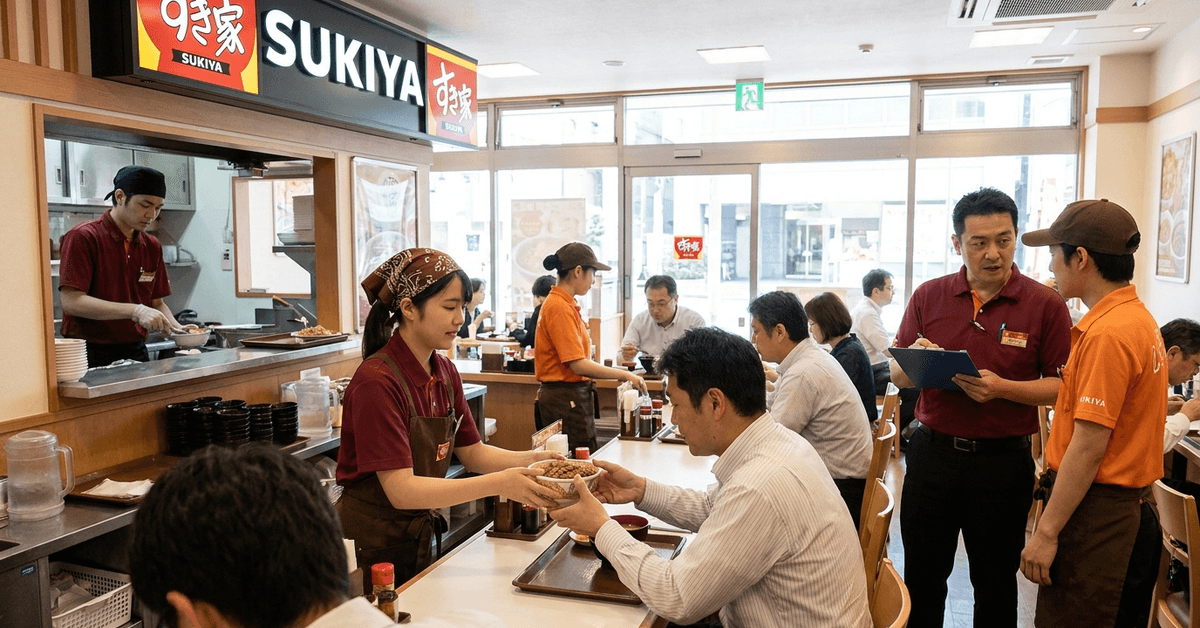
Sukiya runs a lean staffing model. Crew members rotate between the kitchen and the front counter, so the distinction between “front-of-house” and “kitchen staff” is thinner than most restaurant jobs.
Hall and kitchen crew (ホール・キッチンスタッフ)
This is the entry-level position and accounts for the vast majority of Sukiya’s hiring.
Responsibilities cover greeting customers, operating the touch-panel ordering system, assembling gyudon bowls, running the rice cooker, washing dishes, and handling the self-checkout register. New hires train at one of Sukiya’s regional training centers before starting on the floor.
The speed expectation is high. Lunch rush at a busy Tokyo location can mean assembling 60 to 80 bowls per hour across two or three crew members. Sukiya built its business model around minimal staff per shift, and that pressure has not changed after the 2025 overhaul.
Shift supervisor (シフトリーダー)
Supervisors handle scheduling, manage inventory counts, and step in when crew members call out. The hourly bump is modest, but these roles often come with priority access to preferred shift times.
Japanese language ability at roughly JLPT N3 or higher is a practical requirement here, because supervisors communicate with store managers and handle customer complaints.
Deep-night monitoring staff (深夜モニタリングスタッフ)
This is a newer role that appeared after the 2025 scandal. Sukiya created monitoring positions focused on hygiene checks and facility inspections during closed hours.
The listings are sparse, and the role is still evolving. But it signals where the company is spending its post-scandal budget.
How to Find Sukiya Job Listings and Apply
The application process is straightforward, though a few details trip up foreign applicants who are unfamiliar with Japanese hiring norms.
Openings appear in three places:
- Sukiya’s official recruitment site at jobs.sukiya.jp lists all current part-time positions by prefecture, with shift times and base pay displayed upfront
- TownWork and Baitoru, the two biggest baito (part-time) job boards in Japan, carry Sukiya listings with filtering by region, station name, and hourly rate
- In-store postings on windows or near the register still exist at branches that need staff urgently, and walk-in inquiries sometimes lead to same-day interviews
The application form and interview
Online applications ask for basic personal details, desired shift days and times, and previous work experience. Honesty about availability matters more than a polished resume.
Sukiya’s hiring managers care most about how many hours a candidate can commit and whether those hours line up with the store’s gaps. Interviews for part-time crew positions are short, often 15 to 20 minutes, and focus on attitude and schedule fit.
Deep experience in food service is not expected. The interviewer will ask about your visa status, your available start date, and whether you can handle busy periods like weekends and holidays.
Common mistakes foreign applicants make
One mistake that kills applications quickly: listing availability that conflicts with your visa’s work-hour cap. Student visa holders are limited to 28 hours per week during school terms (40 hours during long breaks).
Sukiya’s system flags applications that exceed this, and stores in areas with heavy immigration enforcement are cautious about it.
Another: underestimating the Japanese language requirement. Sukiya does not require formal certification, but functional spoken Japanese at a conversational level is a baseline for customer-facing roles.
What Working at Sukiya Feels Like in 2026
The post-scandal period has changed the internal culture at Sukiya locations. New hygiene protocols added steps to meal preparation.
Crew members now perform documented temperature checks on refrigeration units, visual inspections of all served items, and regular pest-control audits. These tasks add time to each shift without changing the pay.
The one-operator problem Sukiya never fully fixed
Sukiya gained notoriety years ago for its “wan-ope” (ワンオペ, one-operator) system, where a single crew member ran an entire store alone during off-peak hours. Public backlash and labor complaints pushed the company to reduce wan-ope shifts.
A new hire at a suburban store should expect stretches where they are the only person on the floor. My take is that Sukiya’s recruitment materials overstate the “team environment” angle. Glassdoor data shows Sukiya employees giving a 3.4 out of 5 rating on compensation and benefits.
The teamwork reality depends heavily on the specific store and its manager. Some locations run tight, supportive crews. Others leave part-timers feeling isolated during quiet hours.
Advancement from part-time to full-time
Sukiya does move some part-time crew into full-time and supervisory roles. The path runs from crew member to shift leader to assistant manager to store manager.
The company’s parent, Zensho Holdings, is Japan’s largest food-service corporation by revenue, and internal transfers across Zensho’s portfolio of brands are possible for full-time employees.
That said, promotion timelines are not published, and the leap from part-time baito to seishain contract varies widely by region and staffing needs.
Who Should and Shouldn’t Apply to Sukiya
Sukiya can be a solid first job in Japan for someone who needs flexible daytime hours, tolerates fast-paced kitchen work, and has enough Japanese to handle basic customer interactions. The brand recognition on a resume is neutral: neither a standout nor a negative.
For students building Japanese language skills through immersion, the constant customer interaction is a practical classroom. But I would not recommend Sukiya to someone whose primary need is maximum earnings per hour.
The loss of overnight shifts, combined with Sukiya’s base rates sitting near minimum wage, means other chains and industries (convenience stores, warehouse work, delivery apps) can often pay more per hour once premiums and tips are factored in.
Applicants who need 24-hour scheduling flexibility have better options at Yoshinoya or Matsuya in 2026.
Questions People Ask About Sukiya Jobs
Sukiya’s hiring process generates a lot of the same questions, especially from applicants who are new to Japan’s part-time job market.
- Q: Can foreigners work at Sukiya in Japan? Absolutely, as long as you hold a visa that permits employment. Student visas require a separate work permit (資格外活動許可) before starting. Sukiya stores in major cities employ a sizable number of foreign part-timers, and some locations have multilingual staff on hand for training support.
- Q: Do I need JLPT certification to get hired at Sukiya? Sukiya does not list a formal JLPT requirement for part-time crew positions. Functional spoken Japanese matters more than a test certificate. If you can take a customer’s order, confirm it back, and respond to basic kitchen calls in Japanese, you meet the working threshold. Reading kanji on ingredient labels helps but is not make-or-break.
- Q: How many hours can a student work at Sukiya per week? The legal cap is 28 hours per week during academic terms, extending to 40 hours during designated school breaks. Sukiya’s scheduling system is built around this cap, and exceeding it can trigger immigration consequences for both the worker and the employer.
- Q: Did Sukiya raise wages after the 2025 scandal? Base wages followed Japan’s national minimum wage increase in October 2025, but Sukiya did not announce a separate company-wide raise tied to the scandal. The bigger change was operational: added hygiene responsibilities per shift without a corresponding pay bump.
- Q: Is Sukiya still hiring after the contamination incidents? Glassdoor currently lists over 9,000 open positions at Sukiya across Japan. The chain’s hiring volume has stayed high, partly because the scandal accelerated staff turnover at some locations. Stores that lost workers during the shutdown period are still backfilling.
Conclusion
Sukiya remains Japan’s largest gyudon chain, with nearly 2,000 domestic locations and over 650 stores abroad.
The 2025 hygiene scandal reshaped its operations, eliminated overnight shifts, and added new compliance tasks to every crew member’s workload. Applicants who go in expecting the pre-2025 version of this job will be caught off guard.
The opportunity is real, but so is the fine print, and checking the latest details on Sukiya’s official recruitment site before applying saves time and surprises.